HomeGalleryFAQAdvice
Contact
Residential · November 10, 2026
Smart switch installation looks like a ten-minute job on the box. Then you pull the old switch out of the wall and the wires don't match the diagram. That happens a lot in Phoenix, where many neighborhoods were built decades before anyone put a phone app on a light. Here's what an electrician checks before a smart switch goes in, and why some installs turn into a bigger job.
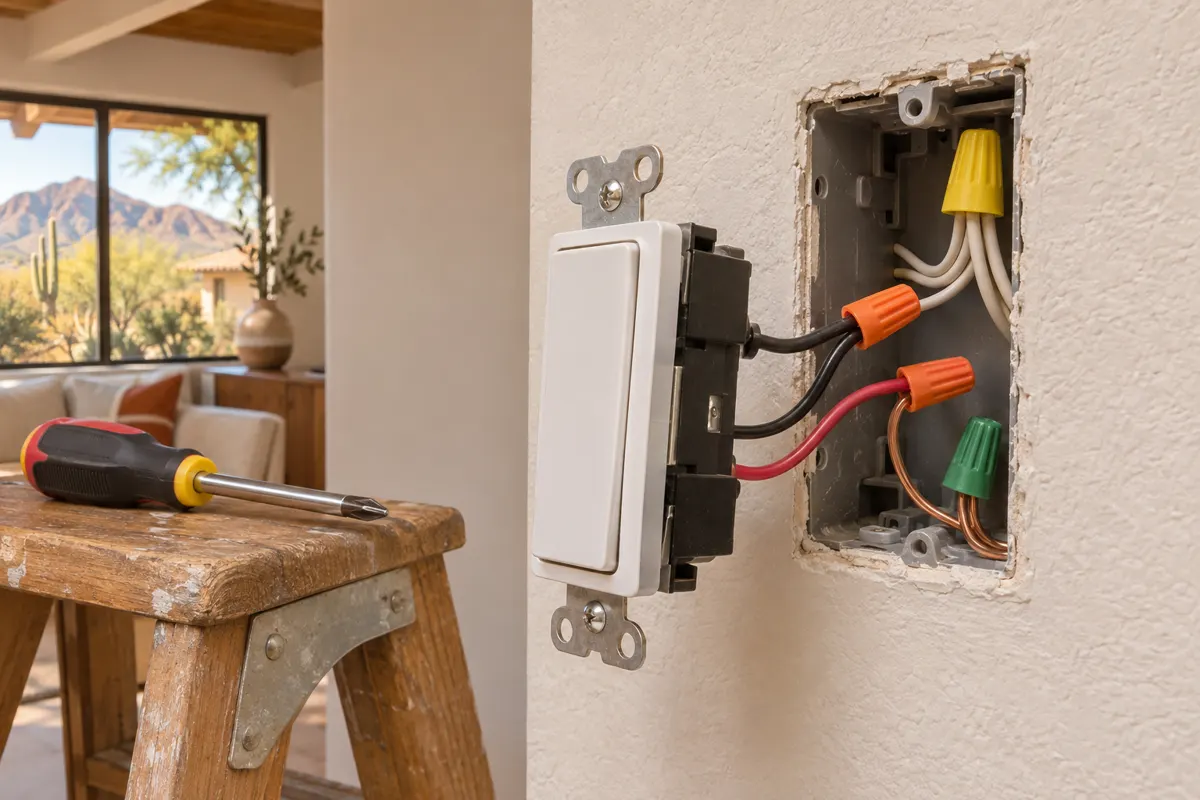
Smart switch installation in a Phoenix home comes down to four questions: is there a neutral wire in the box, is the box big enough, is the switch part of a three-way or four-way set, and will the lights on it behave with a smart dimmer. Answer those first and the rest is usually simple.
A regular switch is just a gate on the hot wire. When it's off, it uses no power, so it only needs the hot coming in and the wire going out to the light (plus ground). A smart switch is a small computer with a radio. It has to stay powered even when the light is off so it can listen for your phone, a schedule or a voice assistant. Most models get that standby power from a neutral wire, the white conductor that completes the circuit.
Many switch boxes in newer homes have a bundle of white neutral wires tucked in the back, spliced together and not connected to the old switch. That's what a smart switch wants. Newer wiring codes generally call for a neutral at most switch locations, which is why newer homes tend to have one.
In many older homes, the power was run to the light fixture first, and only a two-wire cable went down to the switch. That's called a switch loop. Both wires in the box are really the hot and the switched leg, even if one of them is white. There's no true neutral to connect to.
We see this most in the 1950s to 1970s ranch homes found across Tempe, central Phoenix and Scottsdale, but plenty of later homes have it too. You can't tell by color alone. A white wire in a switch loop may be carrying power. That's why "just use the white wire" is a guess, not a plan.
If there's no neutral, the options are:
Never borrow a neutral from a different circuit, and never use the bare ground wire as a neutral. Both are common shortcuts, and both create a shock or overheating hazard that won't show up until something goes wrong.
Check these at every switch you plan to replace.
B and D Electric LLC · banddelectricaz.com
Smart switches are bulkier than the toggle they replace. In an older, shallow box that already holds two cables, a few wire nuts and a ground splice, a smart switch can be forced in so tight that splices loosen or insulation gets pinched. Loose connections are how hot spots start, and our post on hot outlets and burning smells covers what that looks like later. If the box is overfilled, the right fix is a deeper box or an extension ring, not a harder push.
Some Phoenix-area homes built in the late 1960s and 1970s have aluminum branch wiring. Most switches, smart or not, are made for copper only, and connecting aluminum to them directly is a fire risk. If you see dull silver-colored wire in the box, stop and read our post on aluminum wiring in older Phoenix homes before you buy anything.
A lot of Tempe housing near ASU and in neighborhoods like Broadmor dates from the 1950s through the 1970s, and many of those homes are now rentals. Switch loops without neutrals, shallow boxes and the occasional aluminum circuit are all common there. For landlords, smart switches on porch and exterior lights can make sense for schedules between tenants, but plan the wiring first rather than finding out at each box. Our rental turn checklist covers the rest of what to look at.
Swapping one switch for a smart switch, where a neutral is clearly there and the box has room, is a job many handy homeowners do with the breaker off and a tester in hand. Call a licensed electrician when there's no neutral, the wire colors don't make sense, it's a three-way, the box is crowded, you see aluminum, or the switch gets warm after you install it. You can check any contractor's license on the Arizona ROC contractor search.
Send us a list of the switches you want to replace and a photo of each open box (breaker off). We'll tell you which ones are ready for a smart switch and which need wiring work first. B and D Electric LLC is licensed and bonded, Arizona ROC 361086, and our two owners have more than 40 years of combined experience. We handle smart switches, lighting installation and other home electrical work across the Valley. Call or text (480) 828-1181, or request an estimate.

Tell us what's going on and we'll give you a straight answer and a free written estimate. No pressure, no upsell.