Licensed & insured Phoenix electrical contractor  ·  Arizona ROC 361086 24/7 emergency service  ·  (480) 828-1181
Home › Blog › Attic Fan Installation in Phoenix: Wiring,…

Residential · November 8, 2026

Attic Fan Installation in Phoenix: Wiring, Controls and Pitfalls

Attic fan installation comes up in Phoenix every year as soon as the first 110-degree week hits and the upstairs bedroom, or the whole single-story house, won't cool down. A fan that pushes hot air out of the attic sounds like an easy win. Sometimes it is. Sometimes it pulls cooled air out of your living room instead. Here's what an electrician looks at before wiring one, and the questions to answer first.
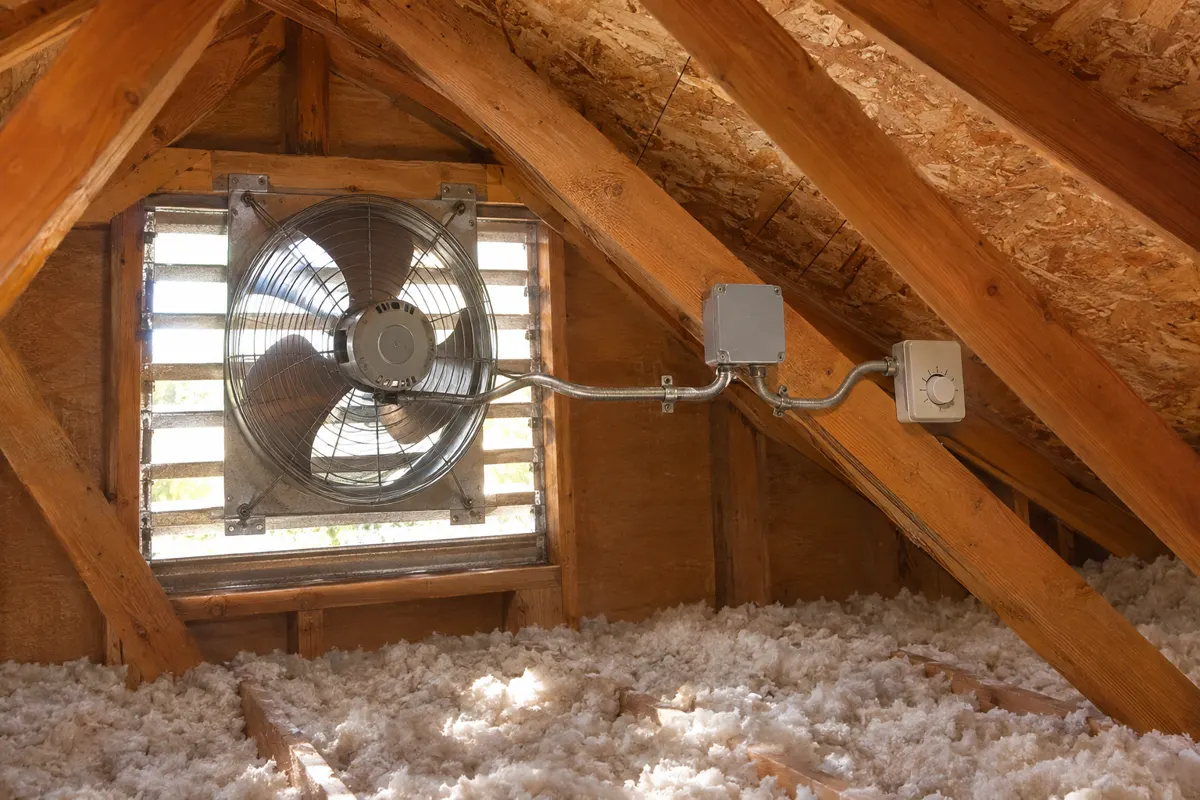
Attic fan installation in Phoenix: a gable-mounted powered attic fan behind louvered vents, wired through metal conduit to a junction box and a dial thermostat control on a roof rafter, with blown-in insulation on the attic floor

Three kinds of attic fans (and why the difference matters)

People say "attic fan" for three different products, and they work in very different ways:

  • Powered attic ventilator. A fan mounted in the roof or in a gable vent that pushes hot air out of the attic. It's usually turned on and off by a thermostat, sometimes with a humidity control. This is the one that needs a wired circuit.
  • Solar attic fan. The same idea, but powered by its own small solar panel. It doesn't connect to your house wiring, so it usually isn't electrician work, though the roof penetration still matters.
  • Whole-house fan. A large fan in the ceiling of the house that pulls air in through open windows and pushes it out through the attic. It cools the house, not just the attic, and only works when it's cooler outside than inside. It also needs a wired circuit, and a wall control in the living space.

In Phoenix, a whole-house fan earns its keep in spring and fall, when evenings drop well below indoor temperature. On a July night that stays in the 90s, or during humid monsoon weather, opening the windows doesn't help, and the AC carries the load.

Does a powered attic fan make sense in a Phoenix home?

A powered attic fan has to get its replacement air from somewhere. If the attic has plenty of intake vents (soffit or eave vents, gable vents), the fan pulls outside air through the attic as intended. If it doesn't, the fan pulls air up through every gap in the ceiling: around can lights, the attic hatch, bath fans and plumbing and wiring holes. That air is the air your AC just paid to cool.

Many Phoenix homes also have the AC air handler and ductwork in the attic, and some still have a gas furnace or water heater up there. A fan that lowers the pressure in the attic can interfere with how a gas appliance vents its exhaust. If there's any gas appliance in your attic, have its venting checked before a powered fan goes in. That's an HVAC and gas question, not just an electrical one.

Important: Before adding a powered fan, seal the ceiling. ENERGY STAR notes that sealing air leaks and adding insulation, including in the attic, can save up to 10% on annual energy bills.

Before you add an attic fan

Answer these first. They decide whether a fan helps or hurts.

✓
Which fan
Powered attic ventilator, solar fan or whole-house fan. Only the first and last need wiring.
✓
Intake vents
The attic has enough soffit, eave or gable vents to supply the fan with outside air.
✓
Ceiling leaks
Gaps around lights, the attic hatch and bath fans are sealed so the fan can't pull cooled air.
✓
Gas appliances
Any gas furnace or water heater in the attic has its venting checked first.
✓
Power source
There's a nearby circuit with room for the fan, or a new circuit is planned from the panel.
✓
Controls
Thermostat, humidity control or wall switch, set to the manufacturer's instructions.
✓
Shutoff
A way to kill power at the fan for service, as the instructions and inspector require.
✓
HOA and permit
HOA approval for a new roof or gable vent, and a permit for new wiring.

Source: Air sealing and attic insulation: ENERGY STAR, Seal and Insulate.

B and D Electric LLC · banddelectricaz.com

How attic fan installation is wired

The electrical side of attic fan installation is simple on paper and hot in practice. Here's what we do:

  • Read the instructions. The fan's installation instructions set the circuit size, the control wiring and any disconnect requirements. The inspector checks against them.
  • Find the power. Sometimes there's an existing circuit in the attic with room for a small fan motor. Often the right answer is a new circuit from the panel, especially for a whole-house fan. Our post on dedicated circuits explains when a load should have its own.
  • Wire the control. A thermostat control turns the fan on above a set attic temperature. A whole-house fan gets a wall switch or timer in the hallway, never a control you have to climb into the attic to reach.
  • Make every connection in a box. Splices go in a covered junction box, cable is supported and protected, and nothing is buried loose in the insulation.
  • Permit and inspection. New wiring usually needs a permit; our electrical permit guide covers when.

Attic heat is hard on wiring, too

A Phoenix attic gets far hotter than the outdoor temperature on a summer afternoon, and that heat is hard on cable insulation, splices and fan motors. When we're up there for an attic fan, we look at what else is in the attic: open splices from an old swamp cooler, brittle cable, or connections that have been cooking for years. Our post on Phoenix heat and your electrical system covers what heat does to wiring. We schedule attic work for the morning whenever we can, for the crew and for the quality of the work.

Signs an existing attic fan has an electrical problem

  • The fan hums but doesn't spin, or spins slowly.
  • It runs all the time, even on cool nights. The thermostat control may have failed or been set wrong.
  • It never comes on in summer. Check the breaker first, then the control.
  • A breaker trips when the fan starts.
  • You smell something hot or see scorching near the fan or its box. Turn it off at the breaker and call.

Fan motors in hot attics wear out, and sometimes replacing the fan with a better-sized one, or removing it and sealing the ceiling, is the smarter fix.

Ahwatukee homes and attic fans

Most of Ahwatukee is single-story and two-story stucco homes built from the 1970s through the 2000s, many with tile roofs, AC equipment in the attic and an HOA. A new roof-mounted fan or a changed gable vent is an exterior change, so check your HOA's rules before work starts. Tile roofs also make roof-mounted fans more involved, which is one reason a gable-mounted fan is often the simpler choice when the attic has a gable wall.

If the real problem is that your AC can't keep up, an attic fan may not be the answer. Our post on AC load on your electrical panel covers the other side, and if a new fan circuit means the panel is out of room, start with our panel upgrade cost guide.

Need an attic fan wired?

Tell us which fan you have or plan to buy, send a photo of the panel with the door open, and let us know whether there are gas appliances in the attic. We'll tell you what the wiring involves. B and D Electric LLC is licensed and bonded, Arizona ROC 361086, and our two owners have more than 40 years of combined experience. We handle this and other home electrical work across the Valley. Call or text (480) 828-1181, or request an estimate.

B and D Electric LLC
Written by Daniel Grayson and Billy Marks, owners of B and D Electric LLC — licensed Phoenix electrical contractor, Arizona ROC 361086. Questions about your own house? Call (480) 828-1181 — we'll give you a straight answer whether or not it turns into work for us.

More advice

Need an electrician in Phoenix?

Tell us what's going on and we'll give you a straight answer and a free written estimate. No pressure, no upsell.

Call (480) 828-1181 Text us Free quote