HomeGalleryFAQAdvice
Contact
EV charging · November 11, 2026
The first EV was easy: one charger on the garage wall and you were done. Now a second EV is coming home, and the question is whether your house can keep both of them charged without tripping breakers or forcing a big upgrade. Here's how an electrician thinks about it, from the simplest fix to the full setup.
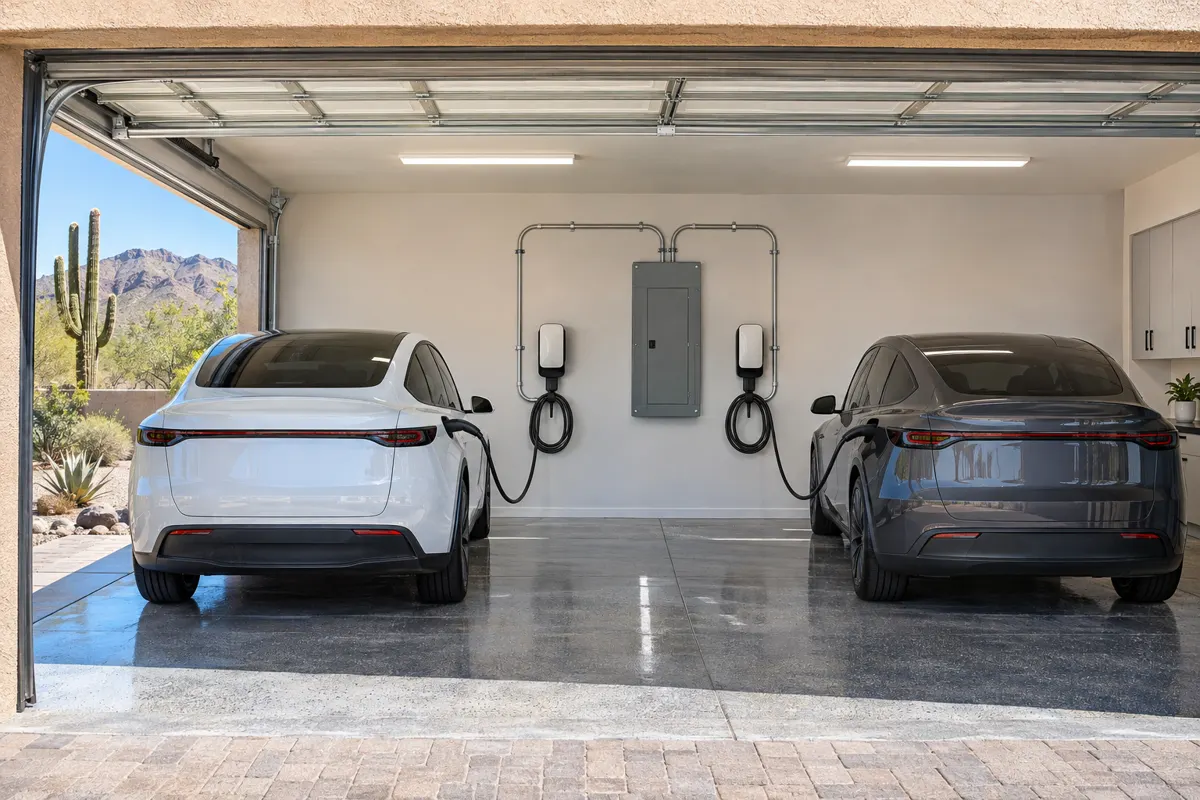
Charging two EVs at home in Phoenix usually comes down to three questions: how many miles each car really drives on a normal day, how much spare capacity your electrical service has, and where the cars park. Answer those and the right setup is usually obvious. Most households don't need two full-speed chargers running at once. They need both cars full by morning.
A car parked in the garage for ten or twelve hours a night has a lot of time to charge. The U.S. Department of Energy's Alternative Fuels Data Center notes that many EV owners meet their daily driving needs by charging overnight with the Level 1 cord that comes with the car, as long as there's an outlet on a dedicated circuit near where they park. Level 2 (240-volt) equipment is for longer commutes, irregular schedules and big batteries.
So before anyone talks about panels, write down a typical week for each car. A short-commute car that comes home half full every night is a very different load than a car that does a long Valley commute and an evening of errands.
If one car drives a lot and the other doesn't, the simplest answer is often to keep your existing Level 2 charger for the heavy driver and give the second car a 120-volt outlet on its own dedicated circuit. It costs the least and adds the smallest load to your panel. The catch is that a shared outlet already feeding a garage fridge or a workbench isn't good enough. Our post on dedicated circuit installation explains why the second car needs its own circuit.
Some households park the cars so one charger can reach either one and simply swap which car plugs in each night, or charge one at night and top off the other on weekends. A longer cable or a smart spot on the wall between the two bays can make this easy. It adds no new circuit at all. It works best when neither car needs a full charge every night.
Many Level 2 chargers can be linked so two units share one circuit. When both cars are plugged in, the chargers split the available power between them. When only one is plugged in, that car gets the full amount. Your panel only sees one circuit's worth of load, so this is often the answer when two full-time drivers each need a real Level 2 charge.
Power sharing only works between chargers built and listed for it, usually the same brand and model, and set up according to the manufacturer's instructions. Two random chargers spliced onto one breaker is not power sharing. That's an overloaded circuit.
Go through this before you buy a second charger.
Source: Level 1 and outdoor-rating points from the U.S. DOE Alternative Fuels Data Center.
B and D Electric LLC · banddelectricaz.com
If both cars need to charge fast at the same time, each charger gets its own 240-volt circuit. This is the most flexible setup and also the biggest load. Whether your home can handle it depends on a load calculation, which adds up everything your house can draw at once and compares it to your service size. If the numbers don't work, the choices are a load management device, power sharing instead of two separate circuits, or a service upgrade. Our post on adding an EV charger without a panel upgrade covers load management in detail, and our 200 amp vs 400 amp service guide explains when a bigger service makes sense.
In a lot of Valley homes the biggest load isn't the cars. It's the air conditioning, which runs hard from late afternoon well into the night for months. Add a pool pump, an electric range and two EVs plugging in when everyone gets home, and that's a lot of demand on a summer evening. Scheduling both cars to charge late at night, after the house cools down, helps your panel and often fits a utility time-of-use plan. SRP and APS both offer plans that price power by time of day, so check with your utility before you pick a schedule. Our post on AC load on your electrical panel explains why summer peaks matter.
In Scottsdale we see both ends of the range. Many newer homes in north Scottsdale have three-car garages, large AC systems, pools and sometimes a casita, so the panel may be big but already busy. Older ranch homes in south Scottsdale often have smaller services and panels with few open spaces. Some neighborhoods also have HOA rules for anything mounted outside, which matters if the second car lives in the driveway. In both cases, the load calculation tells you which option fits before you spend money on a second charger.
Send us a photo of your panel with the door open, a photo of your garage or parking area, and the make and model of your current charger. We'll tell you which option fits your home and whether you need any panel work. B and D Electric LLC is licensed and bonded, Arizona ROC 361086, and our two owners have more than 40 years of combined experience. We handle EV charger installation, panel upgrades and other home electrical work across the Valley. Call or text (480) 828-1181, or request an estimate.

Tell us what's going on and we'll give you a straight answer and a free written estimate. No pressure, no upsell.