HomeGalleryFAQAdvice
Contact
Panels · October 8, 2026
You bought the EV, someone looked at your panel and said "you'll need an upgrade first." Sometimes that's true. Often there's a cheaper, faster path that's just as safe. Here's how to tell.
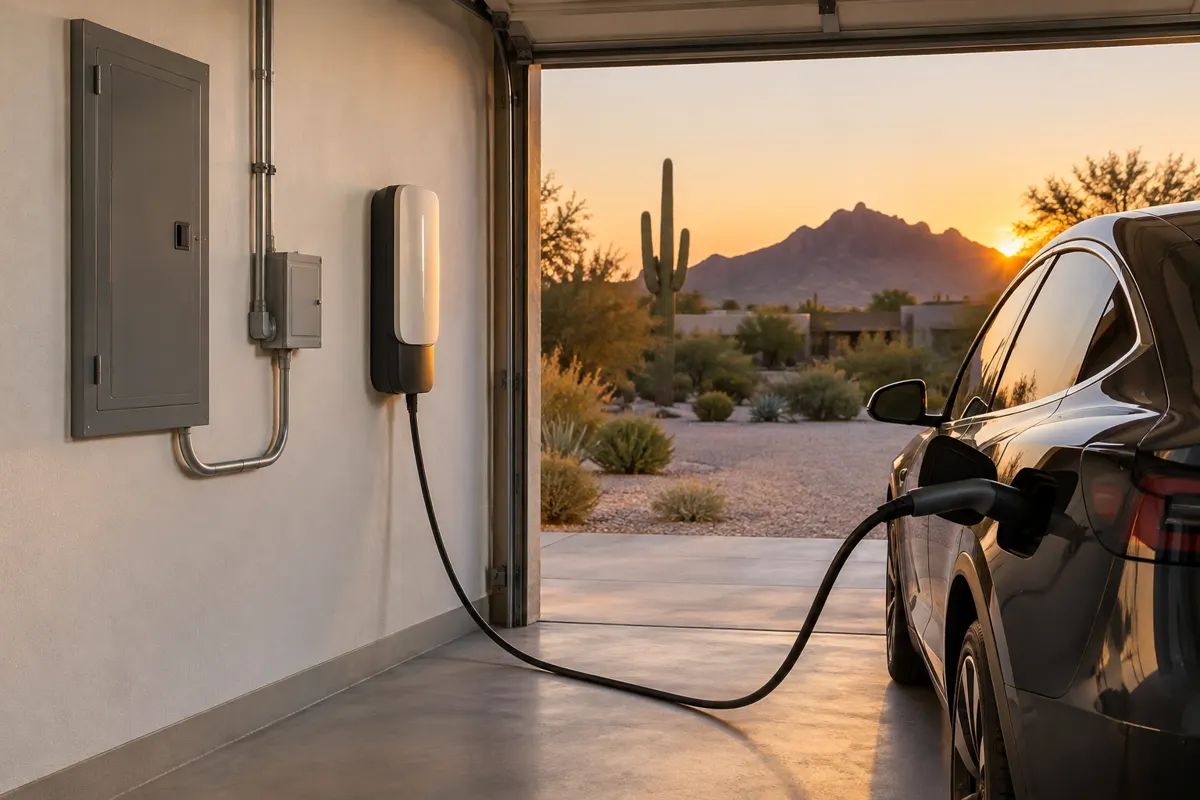
Adding an EV charger without a panel upgrade is possible in a lot of Phoenix homes. The answer depends on two things: what a load calculation says about your service, and whether you're willing to let the charger slow down when the house is busy. If the service has room, you may just need a new circuit. If it's tight, load management can often close the gap. If it's already maxed out, or the panel itself is the problem, an upgrade is the honest answer.
A Level 2 charger runs at or near its full rating for hours at a stretch. A dryer or an oven cycles on and off and is done in an hour. That's why the code treats EV charging as a continuous load and why the circuit and breaker have to be sized with extra margin. A charger set to draw a high amperage takes a big bite out of a 100, 125 or 150 amp service.
In Phoenix, the timing makes it harder. You get home at 5:30, the AC is still running hard, the oven is on, the pool pump may be running, and you plug in the car. Every big load in the house can land at the same moment. That's the scenario the load calculation has to cover.
Before anyone recommends a charger or an upgrade, a licensed electrician should run a load calculation. It adds up the home's square footage, kitchen and laundry circuits, fixed appliances and cooling at full value, then adds the charger. Our post on how much load AC puts on a panel explains why the AC is almost always the biggest number in a Phoenix house.
The result puts you in one of three places:
From simplest to most involved. A load calculation tells you which ones fit your house.
Source: The U.S. Department of Energy notes that electricians can tell homeowners whether a home has enough capacity for Level 2 charging. See the Alternative Fuels Data Center's Charging Electric Vehicles at Home.
B and D Electric LLC · banddelectricaz.com
This is the most overlooked fix. The charger doesn't have to run at its maximum. Most Level 2 units let the installer set the amperage to match the circuit, and a smaller circuit is much easier for a tight service to carry. Most cars sit in the garage for 10 or more hours overnight, and that's enough time to replace a normal day of Valley driving even at a reduced rate. If you need a full charge fast every evening, this won't be enough. For most commuters, it is.
A load management system watches how much current the whole house is drawing, using sensors on the service conductors. When the house gets close to its limit, the system slows or pauses the charger. When the AC cycles off, charging picks back up. Some chargers have this built in. Others use a separate module installed near the panel.
The code recognizes this approach. When a listed energy management system controls the charger, the load calculation can count the managed load instead of the charger's full rating. That's often what lets a 125 or 150 amp house add a charger without a new service. It has to be a listed system, installed correctly and shown on the permit. It isn't a setting someone flips in an app and hopes for the best.
Two approaches fall under this heading:
Smart panels replace or sit beside the main panel and let each circuit be monitored and switched. They can hold the charger back when the AC and range are running, and they pair well with solar and batteries. They're a bigger project than a load management module, so they make the most sense when the panel needs replacing anyway or you're planning solar or battery backup.
Load management is a great tool. It isn't a fix for every house. An upgrade is the right call when:
If you land here, the panel upgrade cost guide explains what drives the price, and our panel upgrade service page covers how we handle permits and the SRP or APS side.
In Paradise Valley we often see the opposite of a small service problem: larger homes with two or three AC units, a pool and spa, sometimes a casita, and now two EVs. The service may be big, but so is the load, and it all peaks on summer evenings. Here, power sharing between two chargers or whole-house load management usually beats adding two full-size circuits. The garage is often far from the main panel, so wire size for the distance and the heat matters too. Equipment has to be rated for a garage that can top 115 degrees in July.
SRP and APS both offer time-of-use plans, where overnight power costs less than the late afternoon peak. Charging overnight helps your bill. It also keeps the charger away from the hours when your AC is working hardest, which is exactly when a tight service is most at risk. Plans and rules change, so check the current options with your utility before you set a schedule.
Send us a photo of your main panel, the label inside the door, the charger you're considering and where you park. We'll tell you whether you need a simple circuit, load management or an upgrade, and give you a free written estimate. See our EV charger installation page for more. B and D Electric LLC is licensed and bonded, Arizona ROC 361086, and our two owners have more than 40 years of combined experience. Call or text (480) 828-1181, or request an estimate.
Tell us what's going on and we'll give you a straight answer and a free written estimate. No pressure, no upsell.