HomeGalleryFAQAdvice
Contact
Panels · October 7, 2026
A full panel doesn't always mean a new panel. Sometimes a subpanel is the right fix, and sometimes it only hides the real problem. Here's how to tell which one your Phoenix home needs before you pay for either.
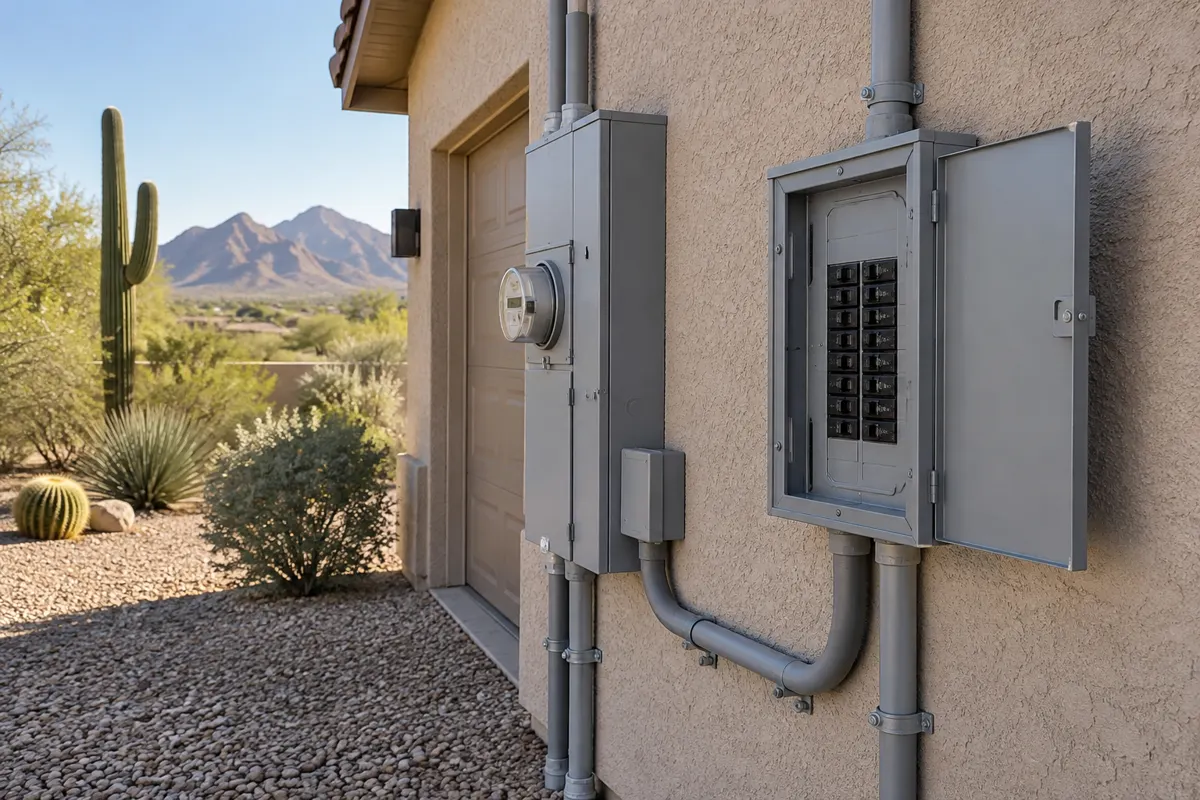
Subpanel vs panel upgrade is one of the most common questions we get from Phoenix homeowners who are adding something: a garage workshop, a casita, a pool heater, an EV charger, a second AC unit. The panel has no open spaces, and somebody has told them they need a new one. Sometimes that's true. Often it isn't. The answer comes down to one distinction most people never hear explained.
Your panel has two separate limits. The first is spaces: the physical slots where breakers go. The second is capacity: how many amps the service can deliver, set by the main breaker, the service wires and the utility's equipment.
A subpanel fixes a space problem. It is a smaller panel fed by one breaker in your main panel, and it gives you new slots for circuits, often right where you need them. What it can't do is add capacity. Every amp that flows through a subpanel still comes through your main breaker. If the house is already short on capacity, a subpanel just moves the problem a few feet away.
A panel or service upgrade is what fixes a capacity problem. That means a larger main breaker and panel, usually new service conductors, and coordination with SRP or APS. It's a bigger job, with a permit and a city inspection, and it's the only thing that actually gives the house more power.
Answer these before anyone quotes you either job.
Source: Any new subpanel or service change in Phoenix needs a permit. See the City of Phoenix Planning and Development Department.
B and D Electric LLC · banddelectricaz.com
A subpanel makes sense when the load calculation shows the service has room, but the panel doesn't. Common Phoenix examples:
A subpanel is a poor fix, and sometimes an unsafe one, in these situations:
The load calculation is the method electricians and plan reviewers use to size a service. It counts the home's square footage, kitchen and laundry circuits, fixed appliances, and heating or cooling at full value, then adds the new load. In Phoenix the AC is almost always the biggest number. Our post on how much load AC puts on a panel walks through it in plain terms.
If the total fits the service, you're choosing between a subpanel and rearranging the existing panel. If it doesn't, you're choosing between a service upgrade and a load management device that limits the new load, such as an EV charger that backs off when the house is busy. Breaker sizes alone never answer the question. Neither does a quick look at the panel.
In Fountain Hills, we see both sides of this question. Homes from the town's early decades are often still on their original service, so a new pool heater or EV charger can push them into an upgrade. Newer hillside homes tend to have bigger services, but the meter, the main panel, the pool pad and the casita are often far apart and at different elevations. There, a subpanel near the load is usually the better design, as long as the feeder is sized for the distance and the heat. Fountain Hills has its own building department, separate from Scottsdale, and we pull the permit there.
Send us a photo of your main panel with the cover on, a photo of the label inside the door, and a list of what you're adding. We'll tell you whether it's a subpanel job or an upgrade, and give you a free written estimate either way. See our panel upgrade services, or the panel upgrade cost guide for what drives the price. B and D Electric LLC is licensed and bonded, Arizona ROC 361086, and our two owners have more than 40 years of combined experience. Call or text (480) 828-1181, or request an estimate.

Tell us what's going on and we'll give you a straight answer and a free written estimate. No pressure, no upsell.