HomeGalleryFAQAdvice
Contact
Residential · October 30, 2026
An RV outlet installation at your Phoenix home lets you keep the batteries charged, run the fridge while you pack, and cool the coach down before a trip instead of loading it at 115 degrees. It's a straightforward job for an electrician, but it's also one of the easiest circuits to get wrong. The most common RV outlet looks like a 240-volt outlet and isn't, and a mistake there can damage an RV's electronics in seconds. Here's what to know before you add one.
Everything starts with the plug on the end of your RV's shore power cord. There are two you'll see on almost every coach, and they are not interchangeable:
Take a photo of your plug and the label near the RV's power inlet. That one picture answers the first question any electrician will ask. If you plan to own the RV for a while, or think you might move up to a bigger coach, it's worth talking through whether a 50 amp outlet makes sense now. A 30 amp RV can plug into a 50 amp outlet with the right adapter. A 50 amp RV on a 30 amp outlet is limited to that 30 amps.
This is the part of an RV outlet installation that matters most. Because the TT-30 has an angled pair of blades and a ground, people often assume it's a 240-volt outlet like a dryer or welder receptacle, and wire it to a two-pole breaker. Plug a 30 amp RV into an outlet wired that way and it gets twice the voltage it was built for. The converter, the air conditioner, the fridge's control board, the microwave and the TV can all be damaged, and an RV repair shop has to test the coach before it's safe to use again.
We see this most often when someone repurposes an existing 240-volt outlet in a garage or installs an RV receptacle as a weekend project. A correctly wired 30 amp RV outlet gets a single-pole 30 amp breaker and 120 volts. A 50 amp outlet gets a two-pole 50 amp breaker, two hots, a full-size neutral and a ground. Before anyone plugs in a new outlet, we meter it and confirm the voltage on every terminal.
You can plug a 30 amp RV into a standard household outlet with an adapter, and for keeping the batteries topped off or running a few lights, that's often fine. What it won't do reliably is run the roof air conditioner, especially through a long extension cord. A 15 or 20 amp household circuit is shared with other outlets, the cord adds voltage drop, and an RV air conditioner starting up on low voltage is hard on the compressor. In a Phoenix summer, running the AC is the whole point, which is why most owners end up adding a dedicated RV outlet.
A 30 amp RV outlet needs one breaker space and is a modest load. A 50 amp outlet needs two spaces, and on a hot afternoon with the RV's air conditioners running at the same time as the house AC, it can add up. Before we add one, we look at the size of your service, what's already on the panel, and whether there are open spaces. Pools, electric ranges, EV chargers and second AC units all count.
If your panel is full but the service has capacity, a small subpanel can be the answer. Our post on subpanel vs panel upgrade explains the difference between running out of spaces and running out of capacity. If you also drive an electric car, plan the RV outlet and the charger together. Our guide to adding an EV charger without a panel upgrade covers load management options that can help when two big loads compete for the same panel. If the panel needs replacing, our panel upgrade cost guide explains what drives the price.
Have these answers ready and you'll get a faster, more accurate estimate.
B and D Electric LLC · banddelectricaz.com
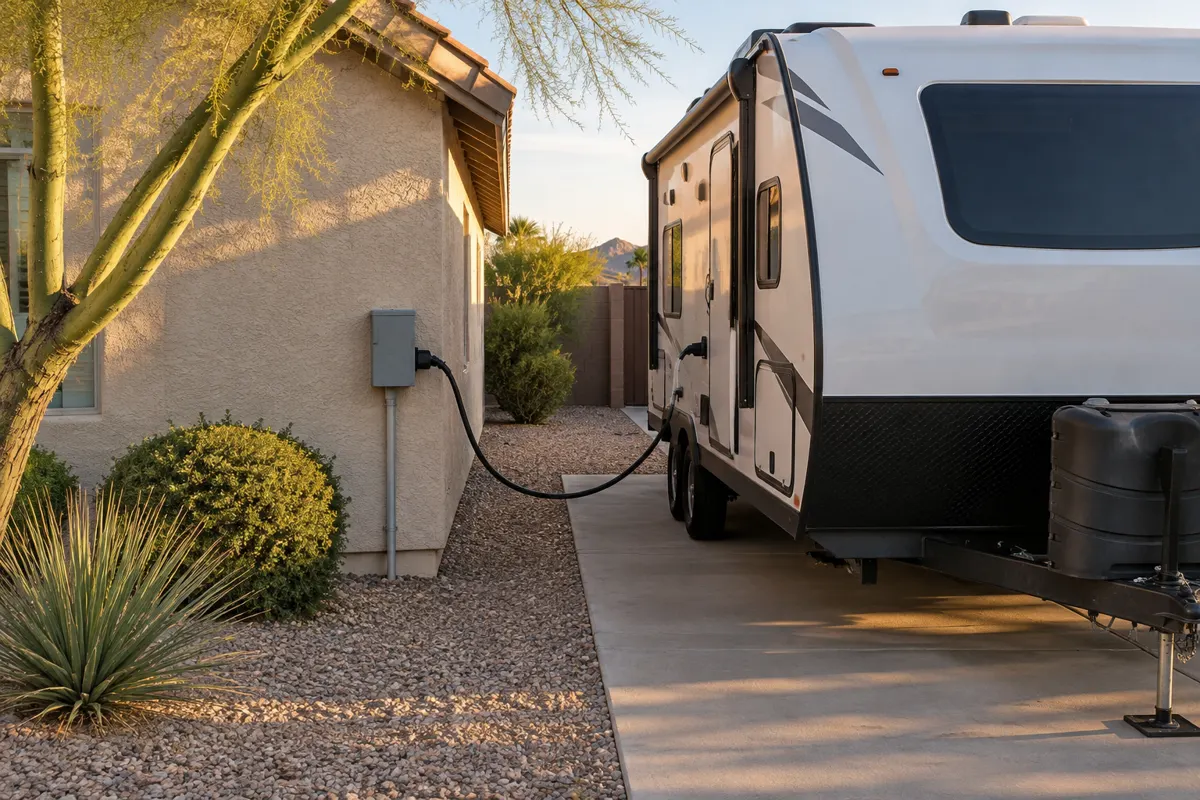
Put the outlet where the RV's power inlet actually sits when it's parked, not where it's easiest to mount a box. Shore power cords are only so long, and adding extension cords is what causes heat and voltage problems. Common setups are a weatherproof RV outlet box on the side of the house next to an RV gate, or a post-mounted pedestal at a side yard parking pad.
If you're also thinking about a 240-volt outlet for tools or a welder in the garage, our post on adding a 240V garage outlet covers that job. Keep the two separate: an RV should have its own correctly labeled outlet, not share a welder receptacle.
Across Phoenix, a lot of homes have an RV gate and a side yard pad, and October through April brings visiting family and snowbirds who want to plug in for a few weeks. Phoenix city code doesn't allow trailers to be parked on residential streets except while loading or unloading, so the RV usually lives on your lot, and the outlet needs to reach it there. If you're in an HOA, check its rules on RV parking before you spend money on an outlet.
Adding a new circuit like this is permitted work in most Valley cities, and a licensed contractor pulls the permit and schedules the inspection. In Phoenix that goes through the Planning and Development Department. A permitted, inspected outlet is also what a home inspector and the next buyer will want to see.
Send us a photo of your RV's plug, where it parks and a photo of your panel, and we'll tell you what the job involves and whether your panel has room. See our residential electrical services page for more of what we do. B and D Electric LLC is licensed and bonded, Arizona ROC 361086, and our two owners have more than 40 years of combined experience. Call or text (480) 828-1181, or request an estimate.

Tell us what's going on and we'll give you a straight answer and a free written estimate. No pressure, no upsell.