HomeGalleryFAQAdvice
Contact
Commercial · October 24, 2026
Most restaurant openings that slip their date do it for boring reasons, and electrical is one of the big ones: a fryer that arrives in the wrong voltage, a space whose service can't carry the line, or a hood that can't be signed off. Here's what to sort out before you sign the lease and order equipment.
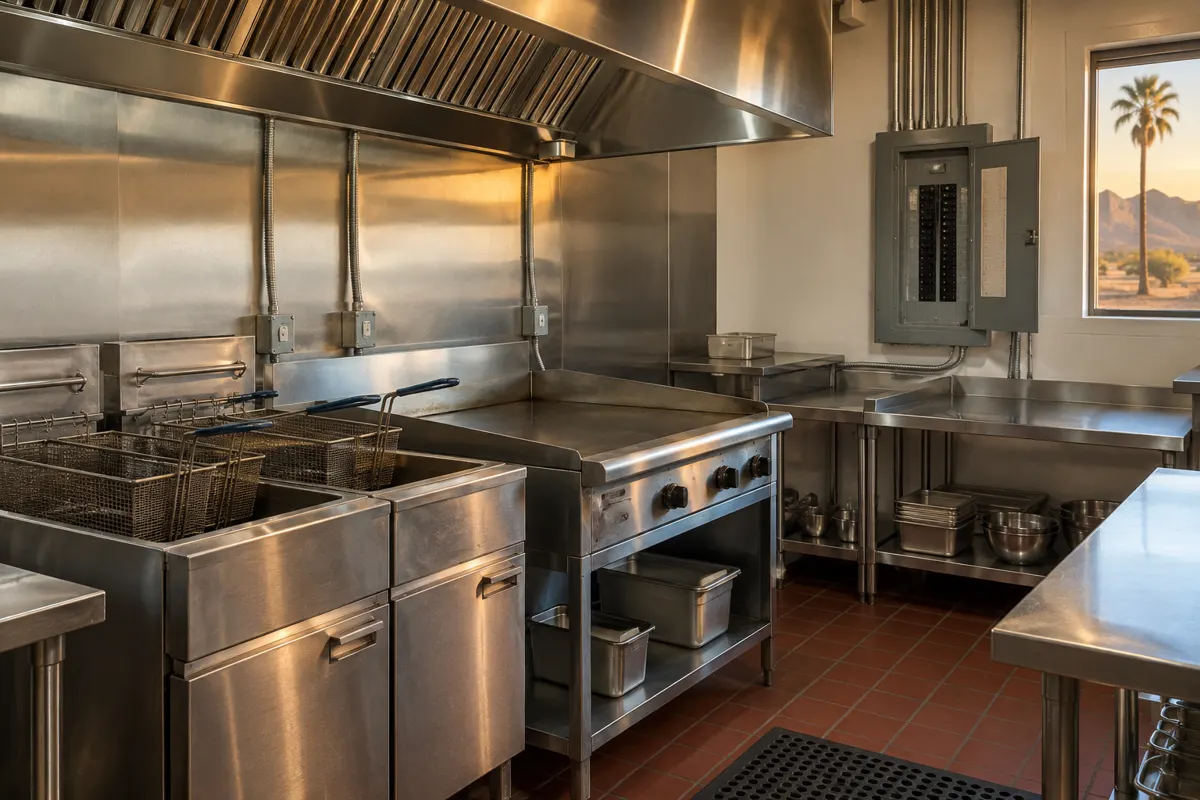
Restaurant kitchen electrical in Phoenix is mostly a planning problem. The wiring itself is straightforward for a commercial electrician. What causes delays and change orders is finding out late that the building's service is too small, that the equipment package doesn't match the voltage in the building, or that the hood and fire-suppression system weren't coordinated with the electrical plans. All of that can be checked early, often before you commit to a space.
Every electrical decision in a commercial kitchen flows from the equipment schedule. Before an electrician can size anything, we need the make and model of each piece, or at least its spec sheet: fryers, griddles, ovens, combi ovens, dish machine, booster heater, walk-in and reach-in refrigeration, ice machines, warmers, and the hood fans. The nameplate on each tells us the voltage, the phase and the current it draws. Add those up with the lighting, HVAC and front-of-house loads and you have a real load calculation instead of a guess.
If the menu is still changing, say so. Swapping a gas fryer for an electric one, or adding a second combi oven, can change the panel and feeder size. It's much cheaper to know that at the plan stage.
A lot of commercial buildings in the Valley are served with three-phase power at 208 volts, while many homes and some smaller buildings have single-phase 240 volts. Commercial cooking equipment is usually built for a specific voltage and phase, and it has to match what the building actually has. A heating appliance built for 240 volts and connected to 208 produces noticeably less heat, so the fryer takes longer to recover and the griddle runs cool during a rush. Some equipment can be ordered or field-converted for either voltage and phase; some can't.
Before you order, have your electrician confirm the building's voltage and phase at the panel, and give that to your equipment dealer in writing. This one step avoids more restaurant change orders than anything else on this list.
A second-generation restaurant space, one that was already a restaurant, often has a service sized for a kitchen, although the last tenant's equipment may have been lighter than yours. A space that was retail or office is a different story. Its service was sized for lights, computers and air conditioning, and an all-electric kitchen can need much more. Upgrading a commercial service means utility coordination with APS or SRP, a landlord's sign-off, and lead time on gear, so it's a schedule item, not just a cost item. Our commercial electrical page covers how we approach load calculations and service upgrades.
Answer these before you sign the lease or place the equipment order.
B and D Electric LLC · banddelectricaz.com
Commercial cooking hoods have a fire-suppression system, and when that system discharges it has to shut off the energy to the cooking equipment underneath: gas through a valve, electric equipment through a shunt-trip breaker or a contactor. The exhaust fan is controlled separately and often keeps running. Getting this right takes coordination between the hood installer, the fire-suppression contractor and the electrician, and it's a frequent reason for a failed final inspection when nobody owns it. We wire the interlock to the suppression contractor's requirements and test it with them.
Commercial kitchens are wet, and electrical codes require ground-fault (GFCI) protection on many kitchen receptacles. Recent code editions have expanded that protection to more equipment. That's good for staff safety, but some older or poorly maintained equipment leaks a little current to ground and trips a GFCI over and over. Exactly which receptacles and equipment need protection depends on the code edition your city has adopted, so we confirm it with the jurisdiction during plan review rather than guessing. If you already have a kitchen where a GFCI keeps tripping, our post on GFCI outlets that keep tripping explains how we track down the cause.
The ENERGY STAR commercial food service equipment page lists certified fryers, griddles, ovens, steam cookers, dishwashers and refrigeration. Efficient equipment uses less energy, which can matter when you're deciding whether an existing service is big enough.
A new or remodeled restaurant kitchen needs a building permit from the city, with electrical plans, and food establishments also go through plan review with the county health department. In practice the electrical, mechanical and plumbing plans have to agree with the hood and equipment layout, so it pays to have your electrician involved before plans are submitted, not after the first round of comments. Our post on what a Phoenix tenant improvement involves walks through the build-out sequence, and our tenant improvement page covers how we work with landlords and general contractors.
If you're adding equipment to a restaurant that's operating, the challenge is keeping you open. Most of the restaurant work we do happens at night or on a weekend so the kitchen doesn't lose a service. On a Chevron Extra Mile convenience store remodel in Phoenix, we wired the new coffee, cold-brew, ice and food-service equipment around the store staying open, with dedicated GFCI circuits for each appliance at the food counter.
Tempe has a lot of restaurant turnover, from Mill Avenue and the blocks around ASU to the strip centers along the main arterials. Many of those spaces have been several different concepts over the years, which means the panel can hold a history of added circuits, abandoned equipment feeds and labels that no longer match. On a second-generation space we start by tracing and labeling what's there before we size anything new. It's also where we most often find a voltage mismatch with the new owner's equipment.
Send us your equipment list and the address, before you sign if you can, and we'll tell you what the space has, what it needs and what will drive the schedule. B and D Electric LLC is licensed and bonded, Arizona ROC 361086, with $1M/$2M general liability, and our two owners have more than 40 years of combined experience. Call or text (480) 828-1181, or request an estimate.
Tell us what's going on and we'll give you a straight answer and a free written estimate. No pressure, no upsell.