HomeGalleryFAQAdvice
Contact
Panels & Service · October 16, 2026
Grounding is the part of your electrical system you never see and rarely think about. It does nothing on a normal day, and it matters most on the worst day.
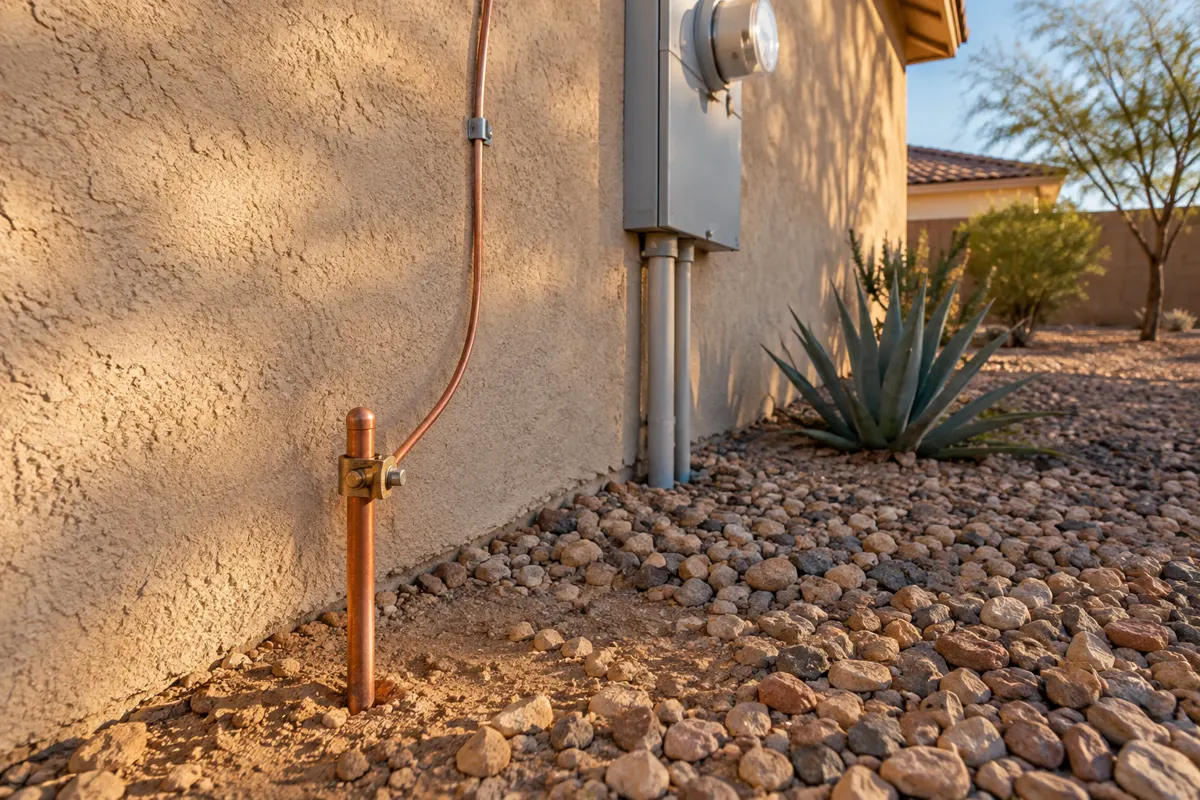
Home electrical grounding in Phoenix gets less attention than it should. Most homeowners only hear about it when a home inspector writes "grounding not verified" in a report, a surge protector's "grounded" light won't come on, or someone feels a tingle from a faucet or the pool rail. This post explains what grounding and bonding actually do, why Valley homes have a few specific weak spots, and what it takes to fix them.
People use the two words interchangeably, but they do different jobs.
A common misconception is that the ground rod is what trips the breaker in a fault. It isn't. The earth is a poor conductor. What trips the breaker is the bonding path back to the panel, where the neutral and ground are connected at the main. That's why a house can have a ground rod and still be unsafe if the bonding is missing, and why both have to be right.
A ground rod works by making contact with the soil, and moist soil conducts far better than dry soil. Much of the Valley sits on dry, rocky, caliche-heavy ground with very little rainfall, which makes a single rod a weaker connection than it would be in a wetter climate.
Arizona is actually where one of the best fixes was invented. During World War II, the U.S. Army needed grounding for storage vaults near Tucson and Flagstaff, where the soil was too dry for ordinary rods. Herbert Ufer found that steel encased in concrete made a much better electrode, because concrete holds moisture and contacts a large area of earth. Today that's called a concrete-encased electrode, or "Ufer ground," and it's why the rebar in many newer foundations is connected to the electrical service. You can read the history of the Ufer ground if you're curious. Older homes often don't have one connected, so they rely on rods and water piping.
This is the grounding issue we think about most in older Phoenix-area homes. Many houses built decades ago used the metal water line as a main grounding electrode, with a clamp on the copper or galvanized pipe where it entered the house. Since then, a lot of Valley homes have been repiped with PEX plastic tubing after leaks in the original pipe.
Plastic doesn't conduct. When the metal water line is replaced with PEX, that grounding connection can be lost without anyone noticing, because the lights still work and nothing trips. If the house had no other properly connected electrode, it can end up poorly grounded. After a repipe, it's worth having an electrician confirm what the panel is actually grounded to.
Metal gas piping is part of the bonding picture. Many homes have corrugated stainless steel tubing (CSST), a flexible gas line usually covered in yellow or black plastic. CSST manufacturers have their own bonding instructions, and Southwest Gas's safety page explains CSST and its lightning concerns. With monsoon lightning every summer, it's worth checking. If you're not sure whether your home has CSST, a plumber can confirm, and we can check whether the gas piping is bonded to the electrical system.
None of these require opening the panel. Look, note it, and call.
B and D Electric LLC · banddelectricaz.com
That last item matters. When some lights get brighter while others dim, or appliances act strangely all at once, the cause is usually a loose or failing neutral, not grounding. It can damage electronics and overheat connections, so treat it as an emergency.
Grounding also matters for surge protection. A whole-house surge protector sends surge energy to the grounding system, so it can only work as well as that system does. Our post on whole-house surge protection covers that in more detail. And if your home has 2-prong outlets, see our post on ungrounded outlets for the options there.
Many grounding problems are a straightforward repair: adding a rod, replacing a clamp or adding a bonding jumper. When the panel is also old or undersized, it makes sense to bring the grounding up to current standards as part of a panel upgrade, since the grounding electrode system is part of the service and gets inspected with it. Our panel upgrade cost guide explains what affects the price of that work.
Mesa has a wide range of housing, from older neighborhoods near downtown to newer subdivisions in East Mesa. The older homes are the ones most likely to rely on a water-pipe ground that may have been lost in a repipe, and to have outdoor clamps that have been sitting in the sun and irrigation water for decades. Most of Mesa gets its electricity from SRP, while the City of Mesa runs its own electric utility for an area around downtown. Either way, grounding and bonding on your side of the meter are the homeowner's responsibility, and work at the service is permitted and inspected through the city. We pull the permit and handle the inspection.
Swapping a clamp looks simple, but the grounding conductor connects to the service, and service conductors stay energized even when the main breaker is off. Driving a rod near a house can also hit buried utility lines, so Arizona 811 has to be called before digging. Leave it to a licensed electrician.
Send us a photo of your panel and the area around your meter, and tell us whether the house has been repiped, and we'll tell you what we see and what it would take to fix it, with a free written estimate. B and D Electric LLC is licensed and bonded, Arizona ROC 361086, and our two owners have more than 40 years of combined experience. Call or text (480) 828-1181, or request an estimate.

Tell us what's going on and we'll give you a straight answer and a free written estimate. No pressure, no upsell.