Licensed & insured Phoenix electrical contractor  ·  Arizona ROC 361086 24/7 emergency service  ·  (480) 828-1181
Home › Blog › Main Breaker Keeps Tripping? What It Means…

Panels & Service · October 15, 2026

Main Breaker Keeps Tripping? What It Means in a Phoenix Home

When one circuit trips, a room goes dark. When the main breaker trips, the whole house does. That's a different problem with different causes, and it deserves a different response.
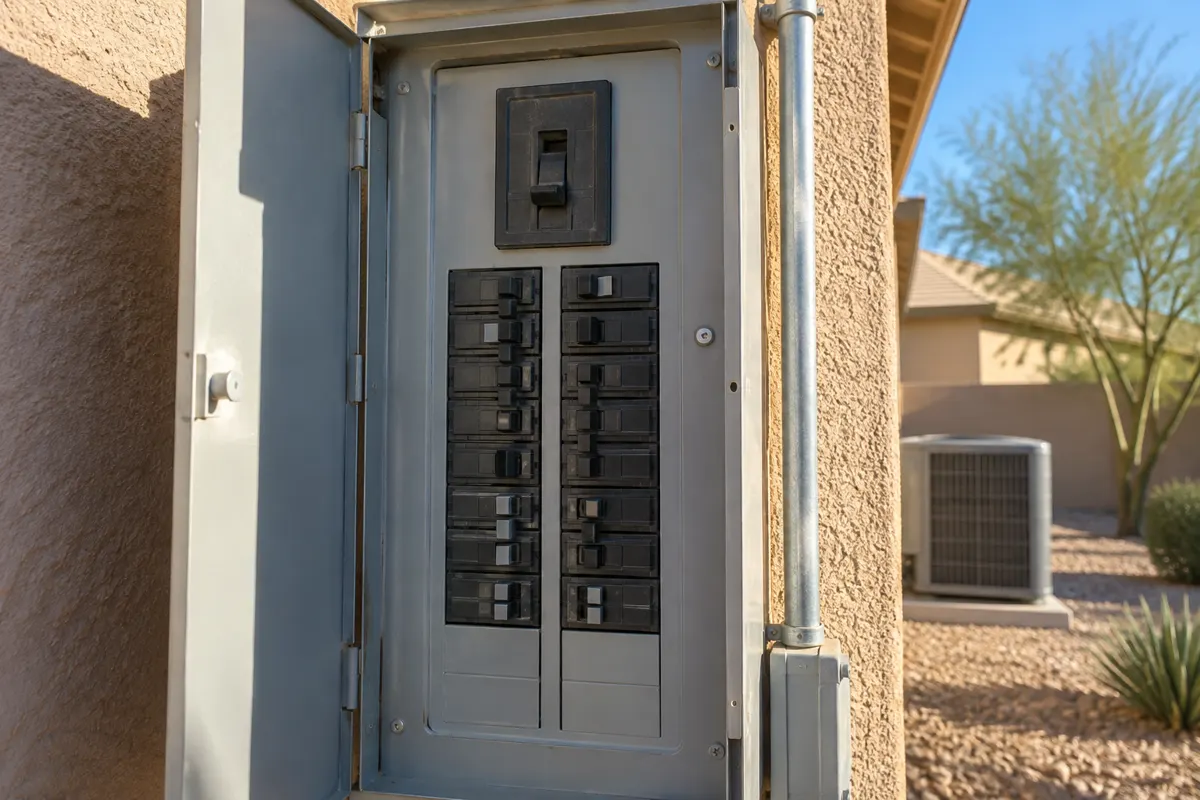
Main breaker keeps tripping: outdoor electrical panel with the door open on a stucco wall of a Phoenix home, AC condenser and palo verde tree in the yard

If your main breaker keeps tripping, your home is telling you something about the service as a whole, not about one outlet or one appliance. In Phoenix it usually shows up on a hot afternoon: the AC is running hard, someone starts the dryer or the oven, an EV is charging, and the entire house shuts off. You reset the big breaker at the top of the panel and everything comes back, until it happens again. Here's what's going on and what to do about it.

Main breaker vs. a branch breaker

Your panel has one large breaker, usually at the top, marked with a number like 100, 125, 150 or 200. That's the main. It protects the panel and the service wires feeding it, and its rating is your home's service size. Every other breaker protects a single circuit. If one of those keeps tripping, our post on why breakers keep tripping walks through the usual causes. This post is about the main.

Before anything else, make sure it really is the main. If the whole house is dark but the main breaker handle is still on, the problem is probably on the utility side: a neighborhood outage or a problem with the service drop or meter. Check your utility's outage map, and if you see a downed line or damaged equipment, stay away from it. APS has safety guidance for that situation, and SRP customers should call SRP.

Why the main breaker keeps tripping in Phoenix homes

There are four common causes. Usually it's one of them, sometimes a combination.

  • The house is using more than the service can carry. This is the most common one. Many Valley homes were built with a service sized for the house of that era. Since then they've added a bigger AC, a pool pump, an EV charger, a casita or a second AC unit. On a 110-degree afternoon those loads all run at once, and the total goes over what the main is rated for.
  • The main breaker is worn out. Breakers are mechanical, and a main that has tripped many times, or has spent decades in a hot enclosure, can start tripping below its rating.
  • A loose or overheated connection. A loose lug on the main, or on the service conductors, creates heat. Heat at the breaker can make it trip, and it can damage the breaker and the bus. This one is a fire risk, not just an annoyance.
  • A fault on a large circuit. A short or a failing motor on a big 240-volt load, like the AC condenser, a water heater or a pool heater, can occasionally trip the main along with, or instead of, its own breaker.

The Phoenix heat factor

Most breakers are thermal-magnetic. Part of how they decide to trip is heat: current warms a strip inside the breaker, and when it gets warm enough, the breaker opens. They're designed and rated for a standard surrounding temperature. A panel on a west-facing wall in July can get much hotter than that inside, so a main that's running close to its rating has less margin on a summer afternoon than it does in January. That's why so many Phoenix homeowners notice main breaker trips between June and September and nowhere else in the year.

This doesn't mean the breaker is defective. It means the house is running close to the limit, and the heat pushes it over. The fix is to reduce the load or increase the capacity, not to keep resetting it. Our post on summer AC load on your panel explains how much of that capacity your cooling system uses.

Important: Never replace the main with a larger breaker to stop the tripping. The main is sized for the panel's bus and the service wires. A bigger breaker removes the protection for both, and that's how panels and service conductors overheat.

What to check yourself, safely

Main breaker tripped: what to check before you call

Everything here can be done without opening the panel cover.

✓
Confirm it's the main
The big breaker at the top is in the off or middle position. If it's still on, call your utility instead.
✓
Turn off big loads first
Set the thermostat higher and switch off the dryer, oven, EV charger and pool equipment before you reset.
✓
Reset once, firmly
Push the main fully to off, then back to on. If it trips again right away, stop and call.
✓
Note the timing
Hot afternoon, a specific appliance starting, or random? Write it down. It helps the diagnosis.
✓
Touch the cover, not the inside
A panel cover that's warm on a mild day, buzzing, or a burning smell means call now.
✓
Look for damage
Scorch marks, melted plastic or rust around the meter or main are a reason to call today.
✓
Find the main's rating
Note the number on the main handle and send it to your electrician with a photo of the panel label.

B and D Electric LLC · banddelectricaz.com

Do not take the panel cover off. The wires that feed the main breaker stay energized even when the main is off, and only the utility can disconnect them.

How an electrician figures out the cause

A proper diagnosis tells you whether you need a new breaker, a repair or more capacity. Here's what we look at:

  • The load. We measure current on the service conductors with the big loads running, and we do a load calculation from what's in the house. That shows whether the service is actually too small.
  • The connections. We check the main lugs and service conductors for heat, discoloration and proper torque. A thermal camera helps find a hot connection you can't see.
  • The breaker itself. If the load is well under the rating and the connections are good, a worn main is likely. Whether it can be replaced depends on the panel: some older panels have no listed replacement main.
  • The panel. Its age, condition and brand. A main tripping in a Federal Pacific or Zinsco panel is a reason to replace the panel, not the breaker.

The fixes, from smallest to largest

  • Repair a connection. If a loose lug is the problem and the breaker and bus aren't damaged, it can be repaired.
  • Replace the main breaker. When the breaker is worn and a listed replacement exists for your panel.
  • Manage the load. If you're only slightly over, load management for an EV charger or rescheduling big loads can keep the total under the limit. Our post on EV chargers without a panel upgrade explains the options.
  • Upgrade the service. If the house simply needs more than the service can deliver, a panel upgrade is the real fix. Our 200 amp vs 400 amp guide covers sizing, and the panel upgrade cost guide explains what drives the price.

Main breaker trips in the Biltmore area

The Biltmore area is a mix of single-family homes, townhomes and condo buildings, and the answer depends on which one you live in. In a house, the main breaker is usually in the meter-main on an outside wall, and it's yours to fix or upgrade. In many condo and townhome buildings, each unit's main sits in a shared meter bank or meter room, and the building's service equipment belongs to the HOA. If your unit's main keeps tripping, we can diagnose your unit's load and panel, but changes to shared equipment have to go through the association.

Most of the Biltmore area is in the City of Phoenix, which requires permits for service work. You can find permit information on the Phoenix Planning and Development site. We pull the permit and handle the inspection for you.

When to call right away

  • The main trips again immediately after you reset it.
  • It won't reset at all.
  • You smell burning or see scorch marks, or the panel cover is hot or buzzing.
  • It's happening more often than it used to.
  • Your panel is a Federal Pacific, Zinsco or another problem brand.

Get a straight answer

Text us a photo of your panel, the number on your main breaker and a note about when it trips, and we'll tell you what we think is going on and what it takes to fix it, with a free written estimate. B and D Electric LLC is licensed and bonded, Arizona ROC 361086, and our two owners have more than 40 years of combined experience. Call or text (480) 828-1181, or request an estimate.
B and D Electric LLC
Written by Daniel Grayson and Billy Marks, owners of B and D Electric LLC — licensed Phoenix electrical contractor, Arizona ROC 361086. Questions about your own house? Call (480) 828-1181 — we'll give you a straight answer whether or not it turns into work for us.

More advice

Need an electrician in Phoenix?

Tell us what's going on and we'll give you a straight answer and a free written estimate. No pressure, no upsell.

Call (480) 828-1181 Text us Free quote