HomeGalleryFAQAdvice
Contact
Panels & Service · October 12, 2026
When a monsoon gust or a falling branch hits the overhead wires to your house, the pipe on your roof that holds them can bend, pull loose or break. Here's how to stay safe, who is responsible for which part, and what it takes to get your power back.
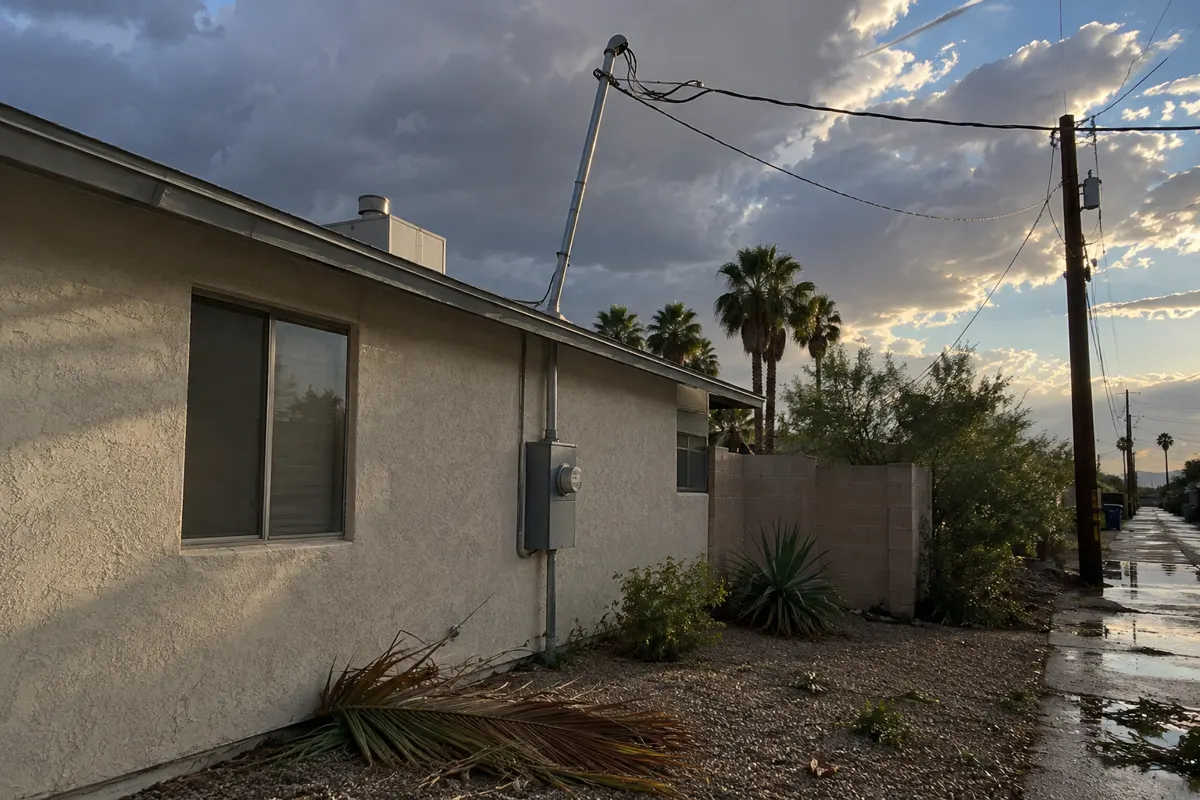
Service mast repair in Phoenix is a call we see after nearly every big storm. The service mast is the metal pipe that sticks up through or alongside your roof and holds the overhead wires coming from the utility pole. It's built to take the pull of those wires, but not the weight of a palm frond, a tree limb or a wind gust that drags the line sideways. When it gives, the damage often runs from the roof down to the meter and the panel.
It helps to know the names, because the utility and your electrician split the work along these lines:
In general, the utility owns the service drop and the meter. The homeowner owns everything from the point where the drop attaches to the house: the weatherhead, the mast, the meter socket and the panel. That split is why a storm-damaged service usually takes two parties. The utility can make the area safe and disconnect or reconnect the drop, but it won't straighten your mast or replace your meter socket. That part is for a licensed electrician. The exact rules vary a little between SRP and APS, which is part of why our guide to SRP vs APS service work exists. For a wider look at who handles each step, see who does what on a service upgrade.
Some damage is obvious, like a mast folded over on the roof. A lot of it isn't. After a storm, look from the ground (never from a ladder near the wires) for these:
Look from the ground. If you see any of these, call before you touch anything.
B and D Electric LLC · banddelectricaz.com
Partial power or lights that get brighter while others dim can mean a damaged connection on one leg of the service or on the neutral. That's not a wait-and-see problem. It can damage electronics and appliances and it's a fire risk. Turn off the main breaker if you can reach it safely, and call.
The order matters. Power can't be safely restored to a damaged mast, and the utility usually won't reconnect until the repair is inspected. Calling an electrician early, while you're still waiting on the utility, can save a day or more without power in the heat.
If the storm only bent the mast and the meter socket and panel are in good shape, replacing the mast and weatherhead is often enough. But storm damage tends to land on the oldest homes, and older homes often have original meter sockets and panels that are already near the end of their life. If the meter socket is cracked or pulled loose, it may make sense to replace it with a new meter-main unit while the power is off anyway. Our post on meter-main combo replacement covers when that's the smarter move, and the panel upgrades page covers full service upgrades. If you want an idea of what a bigger repair involves, our panel upgrade cost guide explains what drives the price.
Sometimes a repair is also a chance to change how the service comes in. Moving the service underground or relocating the mast are bigger projects that involve the utility's design process, but they're worth asking about if your drop crosses trees or a pool area.
Many of Glendale's older neighborhoods are fed by overhead lines from alley poles, with masts on the back of ranch homes built decades ago. Those alleys often have mature trees and palms near the lines, which is exactly what comes down in a monsoon gust. Whether your home is on APS or SRP, the same steps apply: stay clear of damaged lines, call the utility, then get the house-side equipment repaired and inspected.
APS's safety page gives the same advice we do: if a storm damages an area with power lines, stay away and call 911, because the area may still be energized.
Once everyone is safe and the utility has been called, text us photos of the mast, the meter and your panel. We'll tell you what needs repair, pull the permit and coordinate with the utility to get your power back on, with a free written estimate. B and D Electric LLC is licensed and bonded, Arizona ROC 361086, and our two owners have more than 40 years of combined experience. Call or text (480) 828-1181, or request an estimate.
Tell us what's going on and we'll give you a straight answer and a free written estimate. No pressure, no upsell.