HomeGalleryFAQAdvice
Contact
Panels · October 9, 2026
That gray box on the outside wall with the meter on top does more than hold the meter. In a lot of Phoenix homes it is the main shutoff for the whole house. Here's when it needs replacing and what the job really looks like.
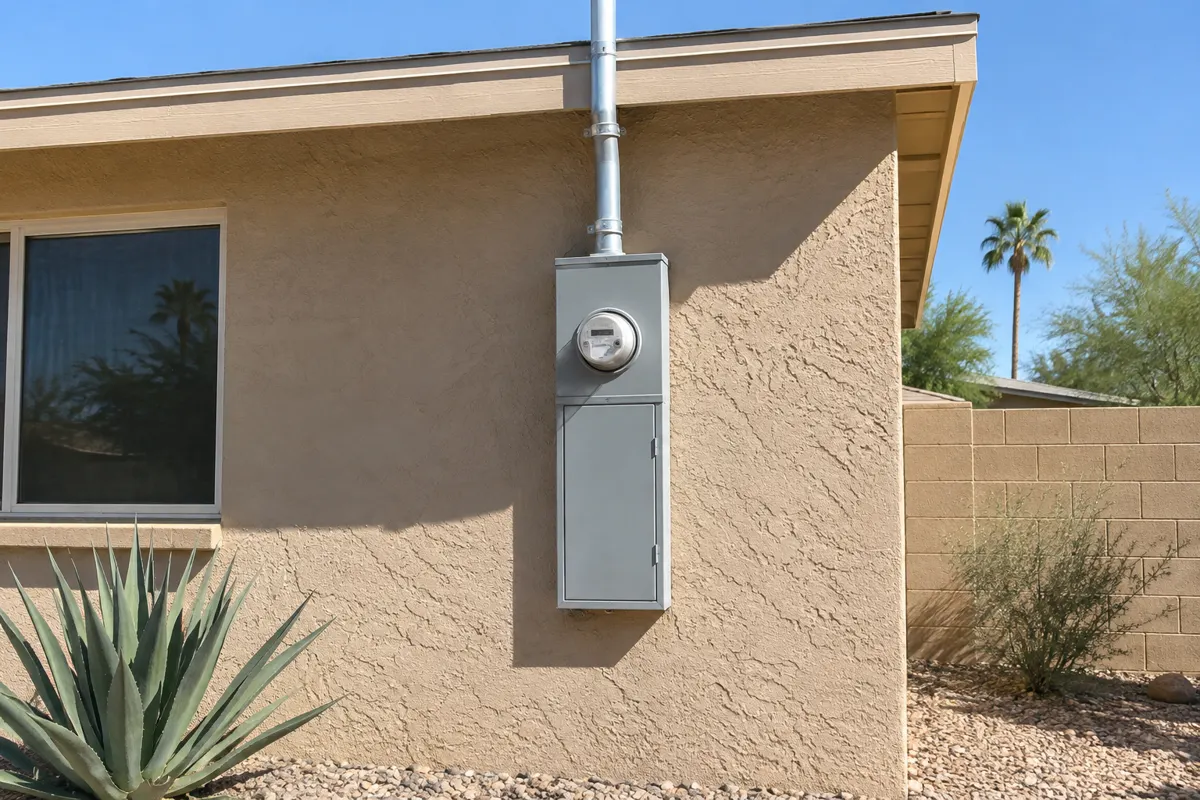
A meter-main combo replacement in Phoenix swaps out the outdoor enclosure that holds both your utility meter and your main breaker. It's one of the most common service jobs we do on older Valley homes, and one of the most misunderstood. People call it a "meter box," a "meter panel" or a "service panel." Whatever you call it, if it's rusted, overheating, outdated or too small for the house, it's the piece everything else depends on.
A meter-main (also called a meter-main combination or all-in-one) is a single enclosure with two sections. The top section holds the meter socket, where the utility's meter plugs in. The section below holds the main breaker, and often the branch breakers for the house too. Some homes have the meter and the main in separate boxes instead. Either way, this equipment is where utility power ends and your home's wiring begins.
One detail surprises a lot of homeowners: the meter itself belongs to SRP or APS, but the enclosure it plugs into belongs to you. If the socket, the main breaker or the box is failing, repairing or replacing it is the homeowner's job, done by a licensed electrician with a permit.
Look from a safe distance. Don't open the panel or touch the meter.
Source: Utilities set their own rules for meter equipment. APS publishes an Electric Service Requirements Manual with a residential pre-approved equipment list. SRP has its own specifications for its territory.
B and D Electric LLC · banddelectricaz.com
Outdoor service equipment in the Valley takes a beating. West- and south-facing walls bake in direct sun all summer, and the enclosure gets hot enough to burn your hand. Heat speeds up the loosening of connections, and a loose connection makes more heat. Then monsoon storms drive water sideways into seams and knockouts, and irrigation heads that spray the wall every morning keep the bottom of the box wet for years. Rust usually starts low and works its way up.
Age is the other half. Many central Phoenix ranch and block homes still have the service they were built with. That equipment was sized for a house with a swamp cooler or one small AC unit, not two heat pumps, a pool pump and an EV charger. Replacement parts for some older enclosures are hard or impossible to find.
Sometimes a single part can be fixed. A loose termination can be cleaned and re-torqued. A worn branch breaker can be replaced. But when the meter socket jaws are burned, the enclosure is rusted through, the main breaker is failing and no listed replacement exists, or the service is too small, replacing the whole meter-main is the safe answer. Patching a rusted box keeps the problem in place, and the inspector and the utility both have to approve whatever goes back on the wall.
Every job is a little different, but the steps are about the same:
Plan on the power being off for a good part of a day. The utility's schedule sets the exact window. Our post on who does what in a Phoenix service upgrade breaks down which steps are yours, ours, the city's and the utility's.
This is the detail that changes the scope most in older Phoenix homes. A surface-mount enclosure hangs on the outside of the wall, and the swap is straightforward. A flush-mount enclosure is recessed into the block or framed wall. Replacing it can mean cutting the opening to fit the new box, or mounting the new one on the surface and reworking how the wires enter. Either way the stucco or block has to be patched. Ask anyone quoting the job how they'll handle the wall.
On our Monte Vista job, a failing exterior meter-and-breaker panel on a Phoenix block home, we put in a new mast and riser, installed a 200 amp meter panel, re-terminated the branch circuits and left the wall patched and the panel labeled.
Newer code editions call for a readily accessible emergency disconnect outside one- and two-family homes, so firefighters can shut off power without going inside. A meter-main with the main breaker in the outdoor enclosure can fill that role when it's installed and labeled correctly. Which rules apply depends on the code edition your city has adopted, and that's something your electrician should confirm on the permit.
If you're replacing the meter-main anyway, it's the cheapest moment to add capacity. The utility visit, the permit and much of the labor happen either way. If a load calculation shows the house is near its limit, or you know an EV, pool heater, heat pump or solar is coming, upsizing now usually beats doing the job twice. If the house is well within its service and nothing big is planned, a same-size replacement is fine. For what drives the price, see our panel upgrade cost guide.
In the older neighborhoods of Phoenix, the 1950s and 1960s block and ranch homes, we see the full list: original fused services, enclosures rusted from decades of flood irrigation and sprinklers, overhead masts that need replacing, and flush-mounted boxes set into block walls. Many of these homes also sit in SRP territory, so we plan the disconnect and reconnect with SRP from the start. Homes elsewhere in the Valley may be served by APS, which has its own process and equipment list.
Text us a photo of your meter-main from a few feet away, plus a close-up of the label inside the breaker door if it's easy to see. We'll tell you whether it needs a repair, a same-size replacement or an upgrade, and give you a free written estimate. B and D Electric LLC is licensed and bonded, Arizona ROC 361086, and our two owners have more than 40 years of combined experience. Call or text (480) 828-1181, or request an estimate.

Tell us what's going on and we'll give you a straight answer and a free written estimate. No pressure, no upsell.