HomeGalleryFAQAdvice
Contact
Wiring · October 19, 2026
Plenty of Phoenix homes from the 1940s through the 1970s still run on much of their original wiring. Some of it is fine. Some of it has reached the point where patching one more circuit stops making sense. Here's how to tell which situation you're in.
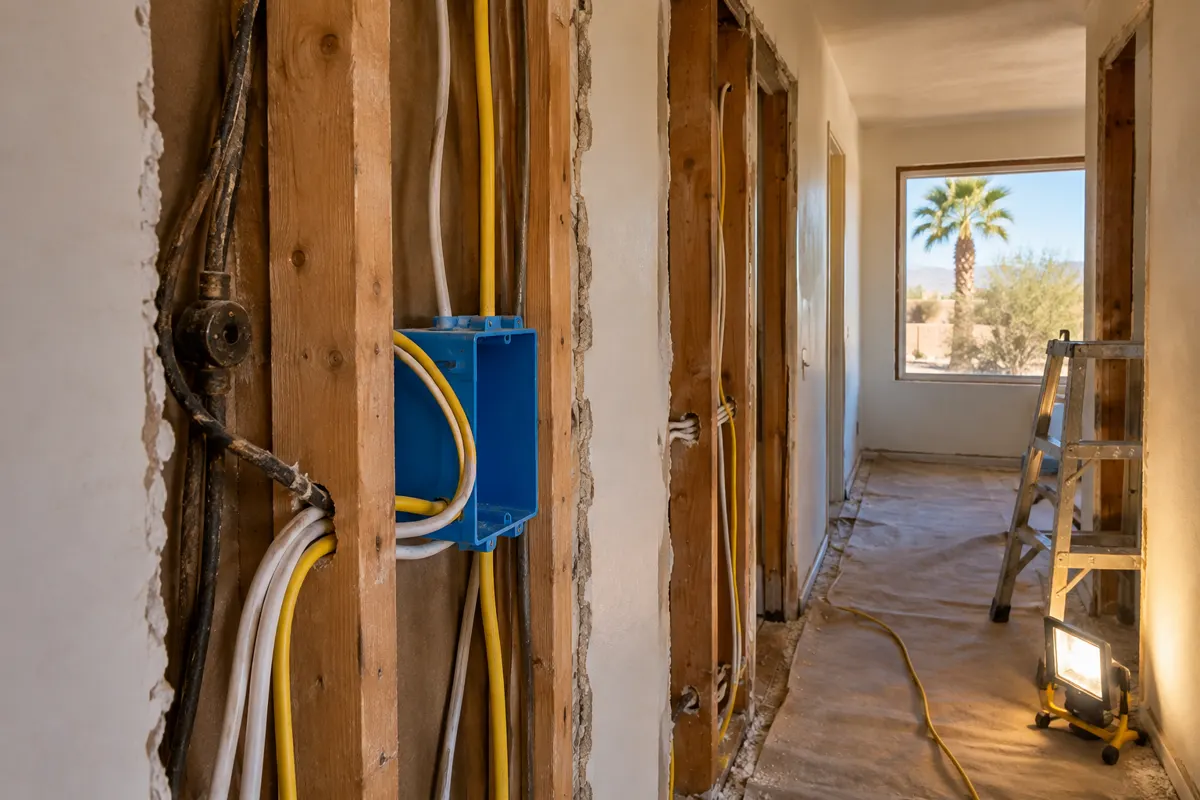
Whole-house rewiring in Phoenix usually comes up for one of three reasons: a home inspection flagged the wiring, a remodel opened the walls, or the owner is tired of dead outlets, warm switches and breakers that never quite behave. A rewire is a big job, so it should be a decision you make with good information, not one you get pushed into. This post covers the signs that point to a rewire, what the work actually involves, when a partial rewire is the smarter move, and how permits work here in the Valley.
No single symptom means you need a whole new wiring system. A pattern of them is what we look for:
No. Age by itself doesn't decide it. Copper wiring from the 1950s and 60s with insulation in good shape can keep working for a long time. What matters is the condition of the wire and insulation, how much of the system has been modified, whether the circuits are grounded, and whether the home has enough circuits for its loads. An older home is not required to be brought up to today's code just because it's old. Code generally applies to new work, which is why a remodel is often when rewiring happens.
That's also why we start with an evaluation, not a quote for a rewire. Sometimes the honest answer is that a handful of circuits need attention and the rest has years left. Sometimes the wire crumbles when we pull a device out of the box, and then patching it room by room just spends money twice.
An electrician can confirm each one. You can note most of them before the visit.
B and D Electric LLC · banddelectricaz.com
A rewire replaces the branch circuits: the cable that runs from the panel to your outlets, switches, lights and appliances. The basic steps look like this:
How long it takes depends on the size of the house, attic access, how much drywall is open and the inspection schedule, so we give you a plan for your house rather than a one-size number. Many homeowners stay in the house during the work, with power off to parts of it at a time.
A full rewire isn't the only choice. Common partial approaches include rewiring the kitchen and baths during a remodel, replacing the circuits that show damage or crumbling insulation, adding new dedicated circuits for the AC, kitchen appliances or a car charger, and replacing ungrounded bedroom circuits while leaving newer additions alone. Our post on two-prong outlets lays out the safe options for ungrounded circuits that don't need new cable right away. A good electrician should be able to tell you which parts are a safety issue now and which can wait.
New wiring connected to a tired panel only solves half the problem. Many older Phoenix homes still have their original 60- to 100-amp service, which was sized long before central AC, pools and EV chargers. A rewire is a natural time to run a load calculation and decide whether the panel or the whole service should be upgraded. Our panel upgrades page covers that work, and the panel upgrade cost guide explains what drives the price. We don't publish rewire prices because they depend so heavily on the house.
In the City of Phoenix, electrical permits and inspections go through the Planning and Development Department. Neighboring cities like Scottsdale and Tempe run their own permit offices. A permitted rewire gives you an inspected record of the work, which matters when you sell, refinance or file an insurance claim. If someone offers to rewire your house without a permit, treat that as a red flag.
We're based in Arcadia, and it's where we see this question most. Much of the neighborhood is 1940s and 50s ranch homes on big lots, with original two-wire circuits and wiring that's been added to for seventy years: an addition from one decade, a remodel from another, a casita or pool from a third. Arcadia also sees a lot of remodel work, and when the walls are already open, rewiring costs far less disruption than doing it later. Arcadia straddles the Phoenix and Scottsdale line, so which city you permit through depends on your parcel. We handle either.
You can read more about how we approach older-home wiring on our residential electrical page.
If your home has old wiring and you're not sure whether it needs a full rewire, a partial rewire or just a few repairs, we'll look at it and tell you straight. B and D Electric LLC is licensed and bonded, Arizona ROC 361086, and our two owners have more than 40 years of combined experience. Call or text (480) 828-1181, or request an estimate.

Tell us what's going on and we'll give you a straight answer and a free written estimate. No pressure, no upsell.